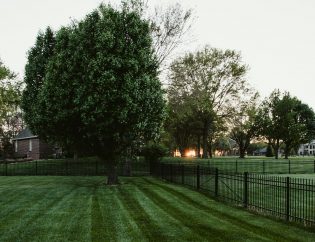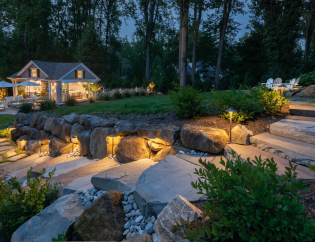
Roswell is a city built on a slope. The ground runs down toward the Chattahoochee along the south side and down toward Vickery Creek, which plenty of people here still call Big Creek, through the middle. Vickery Creek runs about twenty-six miles out of Forsyth County and meets the river at the southern edge of Roswell where Highway 9 crosses, so a great many back yards in this city sit somewhere on the fall between a ridge road and water at the bottom. That is why retaining walls are so common here. It is also why so many of the older ones lean.
A wall on a Roswell lot has three things working against it that a flat lot never has to answer for: rules that come from the river, soil that holds water instead of shedding it, and a slope that keeps feeding both. Get those three right and a segmental block wall will outlast the house. Get the drain wrong and you will be rebuilding inside ten years.
The 2,000-foot line a lot of people have never heard of
If your property sits within 2,000 feet of either bank of the Chattahoochee, it is inside the corridor protected by the Metropolitan River Protection Act, and that changes the paperwork before it changes the shovel. The Atlanta Regional Commission, which reviews work in the corridor, holds a 50-foot undisturbed vegetative buffer along the river and its impoundments, a 35-foot undisturbed buffer along flowing streams inside the corridor, and a 150-foot setback for impervious surface along the river itself.
The part that catches people out is what counts as impervious. Buildings, driveways, decks, patios and pools are all on that list. So a retaining wall that lets you flatten a terrace and then pave it reads, on paper, as a request to add impervious surface inside the corridor, and that needs a certificate: you apply through the City of Roswell, the city forwards it to ARC, ARC returns a finding, and the city issues the certification that authorizes the work. If a project does not increase land disturbance or impervious area past what is already approved for the property, a review may not be needed at all. The only way to know which side of that line you are on is to ask. ARC publishes an interactive corridor map and takes questions at 404-463-3100, and the city planning department can usually answer it in one phone call.
Further from the river, Georgia keeps a 25-foot undisturbed buffer on its warm-water state waters, and that is the rule that covers most of the small creeks threading through Roswell neighborhoods. As for the wall itself, the height at which a city wants a permit and an engineer’s stamp is set locally and is not the same number across north Fulton and DeKalb, so ask Roswell rather than borrowing a figure from a neighbor in Dunwoody. We have written before about how those rules vary around north Atlanta.
Red clay is the wrong thing to build against
The best-practice guidance that careful wall crews work to, published through The Masonry Society and the Concrete Masonry and Hardscapes Association, puts actual numbers on the soil question. For a reinforced wall up to ten feet tall, the fill behind it should be of moderate plasticity: a plasticity index under 20 and a liquid limit under 40. From ten to twenty feet the standard tightens to a plasticity index under 6.
Piedmont red clay routinely misses the first of those, never mind the second, and that is the whole problem in a sentence. Clay swells when it takes on water and shrinks when it dries out, so a wall with clay packed straight against its back face spends every wet spell being pushed and every dry spell being left unsupported. The fix is not a heavier block. It is taking the clay out of the zone immediately behind the wall and replacing it with a graded drainage stone. The guidance is specific about the stone, too: a mix running from one inch down through the sieve sizes with almost nothing passing the No. 200, and not single-size round pea gravel, which locks together and stops moving water. If you are weighing stone against a manufactured drainage layer, we went through that choice in detail in drain mat or gravel behind a wall.
The drain is the wall
Everything that fails on a Roswell slope fails because water had nowhere to go. Three numbers from the same guidance are worth knowing before you hire anyone, because they are easy to ask about and hard to fake.
- Backfill goes in lifts of eight inches or less. Not two feet at a time with a bucket, which is how a wall ends up with soft pockets that settle later.
- Each lift gets compacted to at least 95 percent Standard Proctor density, or to whatever the project engineer specifies.
- The drain behind the wall has to daylight at the face at least every 50 feet. A pipe that collects water and never lets it out is a bathtub with a wall in front of it.
On a terraced Roswell back yard there is a fourth thing: where the water goes once it is out. Daylighting a wall drain into the neighbor’s yard, or straight into a creek buffer, trades one problem for a worse one. It wants a path, and on a long slope that usually means tying the outlets into a drainage line that carries water somewhere it can spread out and soak in. Our notes on where downspouts should actually put the water apply just as well to a wall drain.
What we would do on our own lot here
Dig the base when the clay is workable. A Roswell slope in late February is mud, and mud cannot be compacted to any number worth writing down. Early fall through late autumn is the easier window, before the ground goes wet and stays wet.
Leave the buffer planting alone, and not only because the rules say so. The band of trees and shrub growth along a creek is the cheapest erosion control anyone will ever own, and it is already paid for. Clearing it and then paying for a wall to hold the bank is doing the same job twice.
Keep the excavated clay on site if the design allows it. There is usually a terrace that needs filling behind the top of the wall, and clay is perfectly good fill once it is well away from the back of the block. Hauling it off and trucking stone in to replace it is two sets of truck trips nobody needed.
Run battery equipment, particularly near the water. All of our machines are electric, which near a creek buffer means there is no fuel can and no two-stroke mix sitting on the ground where it can be knocked over.
Before you call anyone
Walk the slope after a hard rain and watch where the water actually goes, because that is the drawing the wall has to answer. Then find out whether you are inside the 2,000-foot corridor, because it decides your timeline more than any other single fact about the job. If you are, build the review time into your expectations rather than discovering it a week before you wanted a crew on site.
If you want to read around the subject first, our walk through wall materials covers what the block choice does and does not change, and the rest of the writing on walls, drainage and patios is collected in our guides.