Every year around the last week of September somebody stops us on a driveway in Dunwoody and asks what we are putting down on the lawn before winter. It is a fair question, and the honest answer depends entirely on what kind of grass is out there. On a fescue lawn, October is the busiest month of the year. On a bermuda or zoysia lawn the fertilizer window shut weeks ago, and putting nitrogen down now is one of the few lawn mistakes in north Georgia that can still be visible next May.
The bermuda rule, and why the date sits where it does
UGA Extension is blunt about the cutoff for warm-season lawns. A final application of nitrogen is fine in August to very early September. After that the grass should be allowed to shut down on its own. Fertilizing in September, UGA’s Forsyth County office writes, can delay dormancy long enough for warm-season turfgrass to suffer cold injury, and late nitrogen also raises the risk of spring dead spot, a disease nobody sees until the lawn greens up in patches the following spring.
That date makes more sense once you put the local freeze numbers next to it. The National Weather Service office at Peachtree City puts Atlanta’s average first freeze at November 13. The earliest on record was October 11, 1906, and the latest was December 18, 1998. So the rule is asking for roughly ten weeks between the last feeding and the first hard night. Nitrogen pushes soft new growth, and soft new growth is what gets hurt. Ten weeks is the cushion.
Where this gets expensive is the bag aisle at the end of September, when the seasonal displays are still stacked high and the grass still looks green enough to want something. A bermuda lawn in Dunwoody in early October is not growing much. It is moving sugars down into its roots and rhizomes. Nitrogen applied then is largely not taken up. It sits on the surface or moves with the next storm, which around here can be four inches over a weekend. That is product bought and lost, and it is nitrogen heading for the creek instead of the lawn. This is the practical version of the sustainability argument we make on every property: the cleanest fertilizer program is the one where nothing goes down at a time the plant cannot use it.
What a warm-season lawn actually wants in October
Three things, none of them nitrogen.
Raise the deck. Normal mowing height for bermuda, centipede and zoysia in Georgia runs one to two inches. Going into fall, UGA recommends mowing at the two-inch mark rather than the low end. A little more leaf means a little more insulation over the crowns.
Keep watering, on the old schedule. Lawns still want about an inch of water a week while they slow down for dormancy, and it still goes on deep and infrequent rather than a few minutes every day. Shallow daily watering builds a shallow root system right before the season that punishes one. We have written separately about when to shut the sprinkler system down, and the short version is that October is too early.
Potassium, if you want to put something down. For bermuda, UGA’s fall suggestion is a product like 0-0-7, with the first two numbers zeros, to improve winter hardiness. Read the bag. If the first number is anything but zero, you are back to the problem above.
One job is already behind schedule by now. Pre-emergent for winter annual weeds goes out in late August to mid September, before nighttime air temperatures stay below 60 degrees or soil temperatures drop to 55. If that did not happen this year, the poa annua is germinating already, and the fix is a post-emergent in late winter rather than a pre-emergent now.
Fescue is the other lawn entirely
On fescue, September and October are the months everything happens. UGA’s seeding window for tall fescue in Georgia is September through October, for a reason that is easy to follow: seed earlier and the seedlings fight heat and disease, seed later and they go into cold weather too small to hold on.
The numbers UGA gives for a new stand are five to six pounds of seed per 1,000 square feet, with a starter fertilizer at one pound of nitrogen per 1,000 square feet. For patching an existing lawn, multiply the share of the lawn that died by six pounds. Half the lawn thin works out to three pounds per 1,000 square feet.
Then the watering, which is where most fescue seed is lost. Keep the top one to two inches of soil moist rather than wet. In practice that means daily water, about a tenth to a quarter of an inch, for the first three weeks. Seed germinates in five to ten days and is ready for its first cut two to three weeks in. Set the mower at two inches to start, then let it up to two and a half or three.
We covered the reseeding side of this in more detail in our piece on overseeding a fescue lawn in Dunwoody, and the month-by-month version for both grass types is in the Atlanta lawn care calendar.
How to tell which lawn you have
Look at it in February. Bermuda and zoysia go the color of straw and stay that way until soil temperatures come back up. Fescue stays green through the winter and struggles in August instead. If half the yard is straw and half is green, you have both, which is common on Dunwoody lots where somebody sodded the sunny front and seeded the shady back. Those two halves want opposite things in October, and that is worth knowing before anybody drags a spreader across the whole property.
What we do on our own route
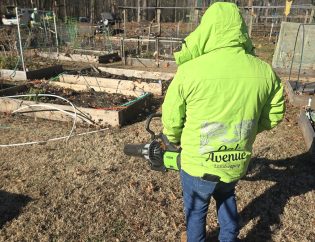
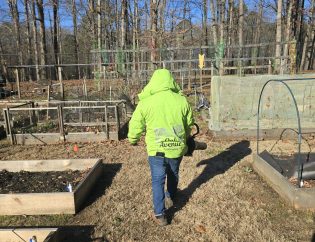
On maintenance properties we finish warm-season nitrogen by the end of August and write the date down, because the pull to add one more round in late September is real and the calendar is the only thing that settles it. Fescue properties get their seeding and starter fertilizer in the first half of October. Anything that looks thin gets a soil test before it gets a product, because the fastest way to waste a fall is to feed a lawn that actually needed lime. Battery equipment helps here too, in a small way that adds up: a quiet machine gets used at eight in the morning on a Saturday instead of being put off to a day when the seed has already dried out.
If you want somebody to sort out which grass is where on your property and what it needs before the first freeze, that is an ordinary part of our maintenance work, and more of these seasonal write-ups live in our guides.
Sources: UGA Extension Forsyth County, “Tips to get your warm-season lawn ready for winter” and “Fall chores to ready warm-season lawns for winter”; UGA Extension, “September and October are perfect for seeding tall fescue lawns”; National Weather Service Peachtree City for Atlanta freeze dates.