Nobody calls a landscaper about a French drain because they find drainage interesting. They call because the back corner has been a swamp since March, or because water is coming in under the basement door. The first question is always the same, and it is a fair one: what is this going to cost?
We will not put a number on a page, because the honest answer is that two yards that look identical from the street can be a long way apart once you know what is under them. What we can do is tell you exactly which things move the number, so that when you get quotes — from us or anyone else — you can see what you are actually comparing.
Where the water is allowed to go
This is the single biggest variable and most homeowners have never thought about it. A drain is only as good as its outlet, and the outlet has to be somewhere the water is legally and physically allowed to end up. If your lot falls away to a street, a ditch or a low corner you own, that is straightforward. If the only downhill is your neighbour’s yard, it is not, and concentrating flow onto adjoining property is how a wet corner turns into a boundary dispute.
When there is no gravity outlet, the job changes shape entirely: infiltration in the ground, a shaped swale, more surface work, and occasionally a pump as the last resort. Every one of those is a different amount of labour. Two neighbours on the same street can get quotes that are nowhere near each other purely because one of them has somewhere to send the water and the other does not.
How far, how deep, and what is in the way
Length and depth are the obvious ones and they are close to linear — twice the trench is roughly twice the digging. What is not obvious is everything the trench has to get past. Tree roots inside a drip line have to be hand dug, not machined, or you kill the tree and pay for it twice. Irrigation lines, invisible fence, gas and low-voltage lighting all have to be located and worked around. Old clay tile from the sixties turns up more often than you would think, usually collapsed.
Then there is the ground itself. Red Piedmont clay digs fine when it is right and behaves like modelling clay when it is wet, and there is decomposed granite under some of these neighbourhoods that stops a trencher dead. None of that is visible from the surface, which is why anyone quoting a drain over the phone from a photograph is guessing.
Whether a machine can reach the work
Access changes the price more than almost anything else of its size. A back yard with a wide gate and a level route is a mini-excavator job. A back yard reached through a four-foot side gate, or down a set of steps, or across a finished patio, is a wheelbarrow job — and a wheelbarrow job is measured in days rather than hours. Steep ground does the same thing, because everything has to be walked instead of driven.
It is worth asking any contractor how they intend to get the spoil out and the stone in. If they have not looked at that, they have not really quoted the job.
What has to be put back
The trench is only part of it. Putting the yard back is a real line: sod or seed over the run, replacing bed plantings that had to come out, cutting and re-laying pavers where the pipe crosses a patio, saw-cutting and patching a driveway. A drain that runs under nothing but lawn is a different job from one that has to cross a finished terrace, even if the pipe is the same length.
What actually goes in the trench
Two drains that cost noticeably different amounts often differ here, and you cannot see it once the sod is down. Rigid perforated pipe in clean washed stone, wrapped so the clay cannot silt it up, will still be working in twenty years. Thin corrugated pipe laid straight into clay with a bit of gravel will be silted solid in a few seasons, and the second install costs more than the first one would have. When you compare quotes, ask what pipe, what stone and what fabric. It is the cheapest question you will ask all week.
The same goes for catch basins, clean-outs and where the run daylights. Clean-outs cost a little now and save a lot the first time something needs flushing.
Whether you need one at all
A fair number of the drainage calls we go out to do not need a French drain. Roof water dumped at the foundation, a flower bed built up against the house, a lawn compacted hard enough that rain sits on top of it, a grade that falls the wrong way for the last ten feet — those are all cheaper to fix than to pipe around, and fixing them sometimes makes the drain unnecessary. We would rather tell you that on the site visit than sell you pipe you did not need, and it is worth asking anyone who quotes you whether the shape of the ground was considered before the trench was drawn.
Questions people ask
Can you give me a rough number over the phone? Not honestly. We can tell you the range of approaches that might apply and what would push a job to the expensive end, but a real figure needs somebody standing in the yard watching where the water goes. The site visit is free and there is nothing to sign.
Does a bigger pipe fix a bad drain? Usually not. Almost every failed drain we dig up failed because of the outlet, the fall, or silt getting into the stone — not because the pipe was too small.
How long does it take? Most residential runs are a day or two of work once we start. The calendar is more often set by access and by whether anything needs a permit than by the digging itself.
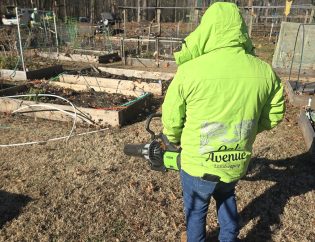
Will it be noisy? Less than you expect. Our equipment is battery powered and charged off a solar trailer, so there is no engine drone running all day next to your neighbour’s home office. A compactor is still loud when it is running, and we will tell you which day that lands on.
The next step
If you have a wet yard, the useful thing is to have somebody look at it while it is still wet. We cover Dunwoody, Sandy Springs, Brookhaven and the surrounding cities. There is more detail on how we approach these jobs on the drainage, French drains and grading page, on French drain installation specifically, and on drainage and grading in Dunwoody. Or just book a free site visit and we will come and look.